
Brackets, mounting plates, gussets, wear plates, covers and the parts of welded fabrications all start as flat profiles cut from plate or sheet. For rail maintenance and manufacturing, the two most common ways to cut those profiles are laser cutting and plasma cutting. Both are computer-controlled and both cut steel accurately, but they suit different jobs.
This article compares the two processes and explains what to supply when ordering cut parts.
How laser cutting works
A laser cutter focuses a high-energy beam onto a small spot on the material, melting or vaporising it, while an assist gas blows the molten material out of the cut. The beam follows a programmed path, producing the profile directly from a CAD drawing.
Laser cutting is known for:
- A narrow cut (kerf), so small features and tight internal corners are possible.
- High accuracy and repeatability on thin and medium plate.
- Clean edges that often need little or no finishing.
- A small heat-affected zone, which limits distortion and changes to the material near the edge.
How plasma cutting works
A plasma cutter passes an electric arc through a gas forced through a fine nozzle, creating a jet of plasma hot enough to melt metal and blow it away. CNC plasma tables follow a programmed path just like a laser.
Plasma cutting is known for:
- Cutting thicker plate economically.
- Speed on medium and thick material.
- A wider kerf and some edge bevel, so very small features are harder to produce.
- A larger heat-affected zone than laser, which matters on some parts that are machined or heat treated afterwards.
Comparing the two for rail parts
Material thickness
For sheet and thin to medium plate, laser usually gives the better result. As plate thickness increases, plasma becomes more practical. The crossover point depends on the specific machines, the material and the accuracy needed, so it is best to let the fabricator choose.
Accuracy and detail
Where holes, slots and small features must be accurate, such as mounting plates with bolt patterns, laser cutting is usually preferred. Where a profile will be machined afterwards anyway, plasma accuracy may be enough.
Edge quality
Laser edges are typically cleaner and squarer. Plasma edges can have a slight bevel and may need grinding before welding or painting, depending on the application.
Heat effects
Both processes heat the edge. For parts that will be welded, machined or heat treated, discuss the heat-affected zone with the fabricator, especially on hardened or wear-resistant plate.
Cost and lead time
For simple profiles in thicker plate, plasma is often quicker and cheaper. For detailed parts in thinner material, laser is often more efficient once the reduced finishing work is taken into account.
A quick comparison
- Thin sheet and light plate: laser usually preferred.
- Thick plate: plasma is often the practical choice.
- Small holes and fine detail: laser.
- Parts to be machined all over afterwards: either; plasma is often sufficient.
- Minimal edge finishing before painting: laser.
- Large, simple profiles in heavy plate: plasma.
These are general tendencies rather than fixed rules. Machine capability varies, and an experienced fabricator will recommend the process that gives the required result at the lowest overall cost, including any finishing work.
What happens after cutting
Cut profiles are rarely the finished product. Typical next steps include:
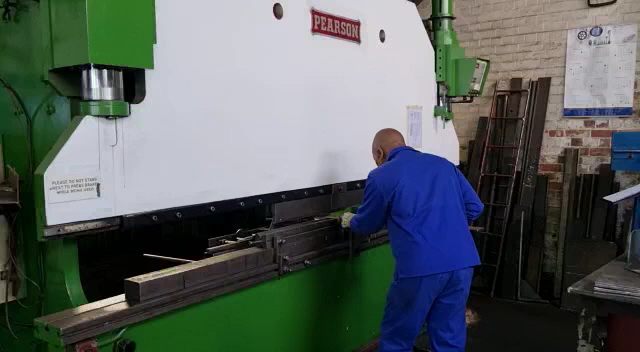
- Bending and forming on a press brake.
- Machining of bores, faces and precision holes. See our article on CNC turning versus milling.
- Welding and fabrication into brackets, frames, guards and assemblies.
- Heat treatment, plating or powder coating, depending on the application.
For fabricated parts, the quality of the welding matters as much as the cutting. Our welding and fabrication work is carried out by coded welders and qualified boilermakers, as described on our services page.
Typical rail applications
- Brackets and mounting plates for equipment on locomotives, wagons and coaches
- Wear plates and liners for bogies, as covered in our article on bogie and undercarriage parts
- Gussets, stiffeners and repair plates for structural repairs
- Covers, guards and access panels
- Components for jigs, fixtures and workshop equipment
What to supply when ordering cut parts
- A drawing or CAD file. We can develop profiles from a drawing or an AutoCAD DWG file.
- Material and thickness. Grade and thickness of plate, including any wear-resistant or high-strength grades.
- Tolerances. Especially for holes and features that mate with other parts.
- Secondary operations. Bending, machining, welding, finishing and coating.
- Quantity. Profiles are often nested together on a sheet, so quantity affects cost.
If you only have a worn or damaged part, it can be measured and drawn up first. See re-engineering obsolete locomotive parts.
How Deomac can help
We offer laser and plasma cutting for profiles of all sizes, alongside welding and fabrication, CNC turning, milling and CNC pipe and tube bending. That means a bracket or fabrication can be cut, formed, machined and welded under one roof. See examples in our gallery, or contact our Australian office with your drawings and quantities.
- laser cutting
- plasma cutting
- profiling
- fabrication
- welding