
Most replacement parts for locomotives, wagons and coaches pass through a machine shop at some stage. Even forged and cast parts are usually finished by machining. The two workhorse processes are CNC turning and CNC milling. Knowing the difference helps buyers and engineers understand quotes, lead times and what information a machinist needs.
CNC turning in brief
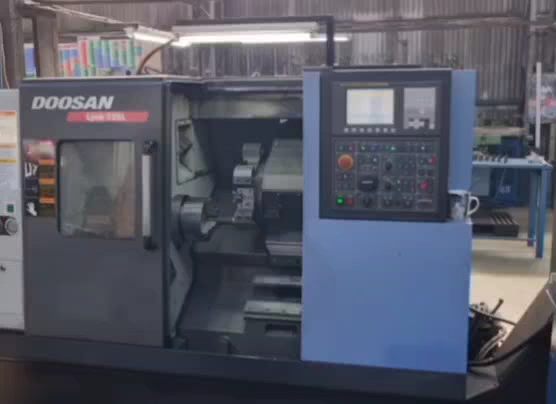
In turning, the workpiece rotates and a stationary cutting tool removes material. A CNC lathe or turning centre follows a programmed path to produce diameters, faces, tapers, grooves, threads and bores.
Turning is the natural choice for parts that are round, or mostly round, about a single axis. Typical rail examples include:
- Pins and bushes for brake rigging, suspension links and couplers
- Shafts, spindles and axles for small assemblies
- Sleeves, spacers and collars
- Threaded fittings and adaptors
- Valve and piston components
- Rollers and wheels for ancillary equipment
Turning is efficient for producing many identical parts. Once a program is proven, repeat batches run consistently, which suits wear items that are used in quantity. At Deomac, CNC turning is one of our core services, used for mass manufacturing of turned parts with qualified programmers to keep turnaround times short. See our services page for the full list.
CNC milling in brief
In milling, the cutting tool rotates and moves relative to the workpiece, which is usually held still on the machine table. A CNC milling machine or machining centre can produce flat faces, pockets, slots, holes, profiles and complex three-dimensional shapes.
Milling suits parts that are flat, block-shaped or irregular. Typical rail examples include:
- Brackets, mounting plates and clamps
- Housings and covers
- Wear plates and liners with machined faces or features
- Levers and links with machined bores and faces
- Valve bodies and manifold blocks
- Keyways, flats and cross-holes on turned parts
Multi-axis machining centres can reach several faces of a part in one setup, which improves accuracy and reduces handling for complex components.
Parts that need both
Many components need both processes. A shaft may be turned to size and then milled for a keyway or flats. A flanged housing may be turned for its bore and spigot, then milled for its bolt holes and mounting faces. Modern turning centres with driven tools can do some milling operations on the lathe, which saves a second setup.
When you receive a quote for a machined part, the number of operations and setups is a large part of the cost. Parts designed or specified with machining in mind are quicker and cheaper to make.
What a machinist needs from you
Whether the part is turned, milled or both, the same information makes a good outcome far more likely.
A drawing, or a good sample
A dimensioned drawing with tolerances is ideal. If you only have a sample, it can be measured and drawn up, as described in our article on re-engineering obsolete locomotive parts.
Tolerances that reflect function
Tight tolerances cost more. Specify them where the fit matters, such as bearing seats, bores and mating faces, and use general tolerances elsewhere.
Surface finish
Bearing surfaces, sealing faces and sliding surfaces need suitable finishes; other surfaces usually do not.
Material and treatment
State the material grade and any heat treatment, hardening, plating or coating. Heat treatment can change dimensions, so the sequence of machining and treatment matters for precise parts.
Quantity
One part, ten parts or a thousand parts are made differently. Quantity affects the choice of machine, fixtures and cost per part.
Our guide on how to request a rail parts quote has a full checklist.
Repeat orders and batch sizes
For wear parts such as pins and bushes, ordering in sensible batches usually lowers the cost per part, because setup and programming are shared across more pieces. Once a part has been made, its drawing and program can be kept for the next order, so repeat batches are quicker to produce. If you use a part regularly, tell your supplier your expected annual usage; it helps them plan material and machine time.
Machining after forging, casting or cutting
Machining is often the finishing step for parts that start life another way:
- Forgings are machined to final size where strength matters.
- Castings are machined on their functional faces and bores.
- Laser or plasma cut profiles are milled or drilled where tighter tolerances are needed.
Our articles on forging, casting or machining a replacement part and on laser versus plasma cutting explain these routes.
Choosing between turning and milling
In most cases the geometry decides. As a rule of thumb:
- Round about one axis? Start with turning.
- Flat, prismatic or irregular? Start with milling.
- Round with flats, slots or cross-holes? Turning followed by milling, or a turning centre with driven tools.
The machinist will normally choose the route. Your job is to describe what the part must do and how many you need.
How Deomac can help
Our workshop offers CNC turning, milling, CNC pipe and tube bending, laser and plasma cutting, and welding and fabrication, so most machined rail components can be made in one place. See examples in our gallery, read about our services, or contact our Australian office with a drawing or sample.
- CNC turning
- CNC milling
- machining
- rail components