
When a rail part has to be made rather than bought, one of the first decisions is how to make it. The same component could, in principle, be forged, cast, machined from solid bar or plate, or fabricated from several pieces. Each route produces a part with different properties, cost and lead time.
The original manufacturer's choice is a good starting point, but it is not always the best answer for a replacement made in small quantities decades later. This article compares the main routes so you can understand the options when ordering a made-to-order part.
Forging
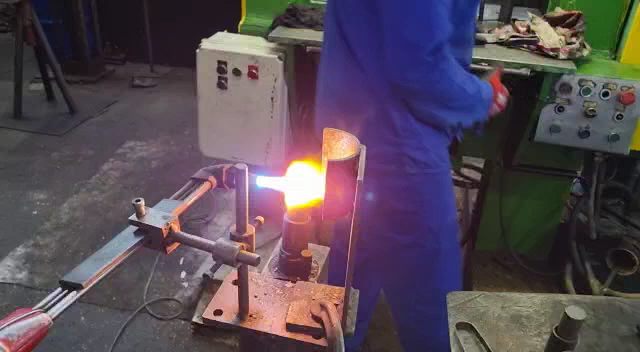
Forging shapes hot metal by pressing or hammering it, either freely or in shaped dies. The process refines the metal's grain structure and aligns it with the shape of the part.
Strengths:
- High strength and toughness, particularly under impact and fatigue loads.
- Few internal defects compared with castings.
- Good for highly stressed parts.
Limitations:
- Dies are needed for close-to-shape forgings, which adds cost for small quantities.
- Complex internal shapes are not possible.
- Forgings usually need machining to reach final dimensions.
Typical rail uses: highly loaded levers, links, hooks, yokes and similar parts where strength and fatigue resistance matter most.
Casting
Casting pours molten metal into a mould. Cast iron, cast steel and non-ferrous alloys such as bronze are all common in rail equipment.
Strengths:
- Complex shapes, including internal passages, in one piece.
- Economical for parts with complicated geometry, especially in larger quantities.
- Good for housings, bodies and parts with thick and thin sections.
Limitations:
- A pattern or mould is needed, which takes time and money to make.
- Castings can contain porosity or other defects, so quality control matters.
- Functional faces and bores still need machining.
Typical rail uses: housings, valve bodies, covers, brackets with complex shapes and some running gear components.
Machining from solid
Machining from solid starts with bar, plate or a block and removes material with CNC turning and milling until the part remains.
Strengths:
- No tooling such as dies or patterns, so it is quick to start and well suited to small quantities.
- High accuracy and good surface finish.
- Easy to change the design between batches.
Limitations:
- Material waste can be high for parts with a lot of material removed.
- For large or complex shapes, machining time and material cost rise quickly.
- The grain flow of bar or plate is not shaped to the part, which matters for some highly loaded components.
Typical rail uses: pins, bushes, shafts, spacers, valve parts, small brackets and prototypes. See CNC turning versus milling for more.
Fabrication
Fabrication cuts plate and sections to shape and welds them together. It is a practical way to make brackets, frames and housings, especially when a casting pattern is not available. Profiles are often laser or plasma cut first, as described in laser versus plasma cutting.
Where heat treatment fits in
Whichever route is chosen, heat treatment often determines how the part performs in service. Common treatments include:
- Normalising and annealing to refine structure or relieve stresses.
- Hardening and tempering to achieve strength and toughness.
- Surface hardening to resist wear on bearing or sliding surfaces while keeping a tough core.
Heat treatment can change dimensions, so precision features are often finished after treatment. Plating and coatings may follow to protect against corrosion or wear.
A worked example: a worn lever
Imagine a brake or suspension lever that has worn at its pin holes and is no longer available. The original was forged. There are several ways to replace it:
- Forge a new one. The closest match to the original, but a new die may be needed, which only makes sense for a reasonable quantity.
- Machine it from forged or rolled bar. No die is needed and the first part can be made quickly, but the engineering team should confirm the material and grain direction are acceptable for the loads.
- Repair the original. Worn holes can sometimes be bored out and bushed, restoring the part at a fraction of the cost, if your standards allow it.
Each option is reasonable in the right circumstances. The best answer depends on quantity, urgency, loads and what your engineering team will approve.
Choosing the route for a replacement part
Questions that usually decide the route:
- How is the part loaded? Highly stressed or impact-loaded parts lean towards forging, or machining from forged bar.
- How complex is the shape? Complex internal features lean towards casting.
- How many are needed? Small quantities favour machining from solid or fabrication, which avoid tooling costs.
- How quickly is it needed? Machining from solid is usually the fastest route to a first part.
- What did the original use? If the original was forged or cast, a change of route needs engineering review, especially for safety-critical parts.
Rail operators in Australia manage changes to safety-critical parts within their own engineering standards, so check what approval a change of material or manufacturing route needs before ordering.
How Deomac can help
Our capabilities include CNC turning and milling, welding and fabrication, laser and plasma cutting, heat treatment, forging, casting, spring work and plating. That lets us recommend the route that suits each part rather than the one that suits a single machine. If you have an obsolete or hard-to-get part, read re-engineering obsolete locomotive parts, see our services, or contact our Australian office with a sample, drawing or part number.
- forging
- casting
- machining
- heat treatment
- manufacturing