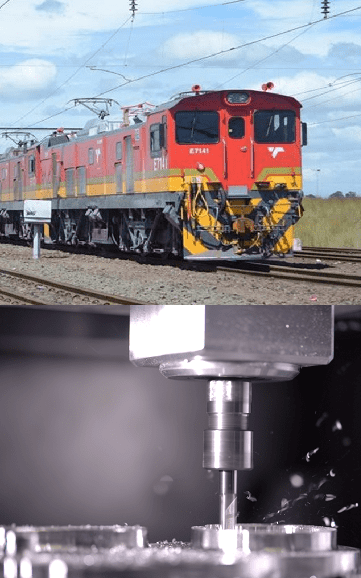
Every fleet manager knows the moment: a unit is out of service, the part that failed is identified, and the supplier says it is no longer made. Locomotives, wagons and coaches routinely stay in service for decades, far longer than the production run of many of their components. When the original manufacturer has moved on, the part still has to come from somewhere.
Re-engineering is often the answer. Instead of waiting for a used part to turn up, a replacement is designed and manufactured from what you already have: a worn sample, an old drawing or a part number. This article explains how that process works and what you can do to make it faster.
What re-engineering actually means
Re-engineering (sometimes called reverse engineering) is the process of working out exactly what a part is, how it is made and what it needs to do, and then producing a new part that does the same job. It covers far more than copying dimensions. A good re-engineered part takes into account:
- Geometry: every dimension, tolerance, thread, radius and surface finish that matters to fit and function.
- Material: the grade of steel, cast iron, bronze or other material, and any heat treatment the original received.
- Function: the loads, temperatures, pressures and wear the part sees in service.
- Manufacturing route: whether the part is best machined from solid, forged, cast or fabricated.
- Inspection: how the finished part will be checked before it is fitted.
At Deomac we are equipped to quote and make products from a sample, a drawing or a part number. Our re-engineering of parts service covers design, development and manufacture, so the work stays in one place from the first measurement to the finished component.
Starting points: sample, drawing or part number
Working from a sample
A physical sample is the most common starting point. Even a worn or broken part tells an engineer a great deal: overall geometry, mating features, wear patterns and often the original manufacturing method. Worn surfaces are measured with care, because the aim is to reproduce the part as it was designed, not as it is after years in service. Where a mating part is available, it helps confirm fits and clearances.
Working from a drawing
An original or later drawing gives dimensions and tolerances directly and often specifies the material and finish. Older drawings may use superseded material specifications or units, so part of the job is translating them into materials and processes available today without changing how the part performs.
Working from a part number
A part number on its own can be enough when it identifies a component in a known assembly. It lets us research the application, find comparable parts and confirm details with you before anything is made.
The re-engineering process step by step
- Enquiry and information gathering. You send the sample, drawing or part number, along with the application (which unit, which assembly) and the quantity you need.
- Measurement and analysis. The part is measured and examined. Critical features, materials and any heat treatment are identified.
- Drawing and modelling. A new drawing or model is produced using CAD software, so the part is fully documented for future orders as well as this one.
- Choosing the manufacturing route. Depending on the part, this may be CNC turning, milling, laser or plasma cutting, welding and fabrication, forging, casting or a combination.
- Manufacture. The part is made and, where required, heat treated or plated.
- Inspection and approval. The finished part is checked against the drawing before dispatch. For a first article, many operators will want to inspect and trial it before ordering in quantity.
Because the new drawing stays on file, repeat orders are far simpler than the first one. That is one of the quiet benefits of re-engineering: once it is done, you are no longer dependent on a single source.
When re-engineering makes sense
Re-engineering is not the right answer for every part, but it is worth considering when:
- The original manufacturer no longer supplies the part, or has stopped supporting that model.
- Lead times for the original part are too long for your maintenance plan.
- The only available supply is used or reconditioned stock of uncertain condition.
- A part fails repeatedly and you want to improve material or design within the original envelope.
- You need a small quantity of a part that is not worth a large supplier's attention.
For parts that are still in production, it is often quicker to source them directly. Our global trade service covers OEM and aftermarket parts, and our article on OEM versus aftermarket locomotive parts explains how to choose between them.
Safety-critical parts need extra care
Parts in braking systems, running gear, couplers and similar assemblies are safety-critical. In Australia, rail operators manage these parts within their own safety management systems and engineering standards, and most will have an approval process for any new or alternative component. Before ordering a re-engineered safety-critical part, check what your organisation needs: drawings, material certificates, inspection reports or a trial period. Telling us at the start means the right documentation is planned in, not chased afterwards.
How to make your re-engineering enquiry faster
The more we know up front, the quicker a reliable quote comes back. Useful information includes:
- Clear photos of the part from several angles, including any markings or numbers.
- Any drawings, even old or partial ones.
- The make and model of the locomotive, wagon or coach, and where the part sits in it.
- The quantity you need now and expect to need over the next year or two.
- Any known problems with the original part, such as premature wear or cracking.
- Documentation or inspection requirements from your engineering team.
Our guide on how to request a rail parts quote goes through this in more detail. If you already know the part number, you can also search our parts list first.
Choosing a manufacturing route
The method used to make the new part affects its cost, lead time and performance. A shaft or bush is usually turned on a CNC lathe; a bracket might be laser cut and welded; a highly loaded part might be forged and then machined. Our articles on CNC turning versus milling and on forging, casting or machining a replacement part explain how these choices are made.
Talk to us about an obsolete part
If a unit is waiting on a part that nobody seems to make any more, send us what you have. Our team can review a sample, drawing or part number and advise on the quickest practical route back into service. Contact Deomac Australia to start the conversation, or read more about our company and see examples of our work in the gallery.
- re-engineering
- obsolete parts
- reverse engineering
- locomotive spares